Login and account creation: One sign-in for web, mobile, and desktop
- Identity
- Product design
- 2025
- Key result
- −80% login support tickets
- User value
- Sign-up by company name, and a code to get back in instead of a password reset.
- Business value
- Fewer support tickets, and one login service to maintain instead of three.
- Stack
- Figma
- WebView
- Related case studies
Problem
Web, mobile, and desktop each had their own login, and getting in was our top support issue. Sign-up was worse: each organization has its own way in, like single sign-on, an email allowlist, or a registration code, and users didn’t know which was theirs. Our goal was one sign-in that works the same everywhere and gets people back in when they forget something.
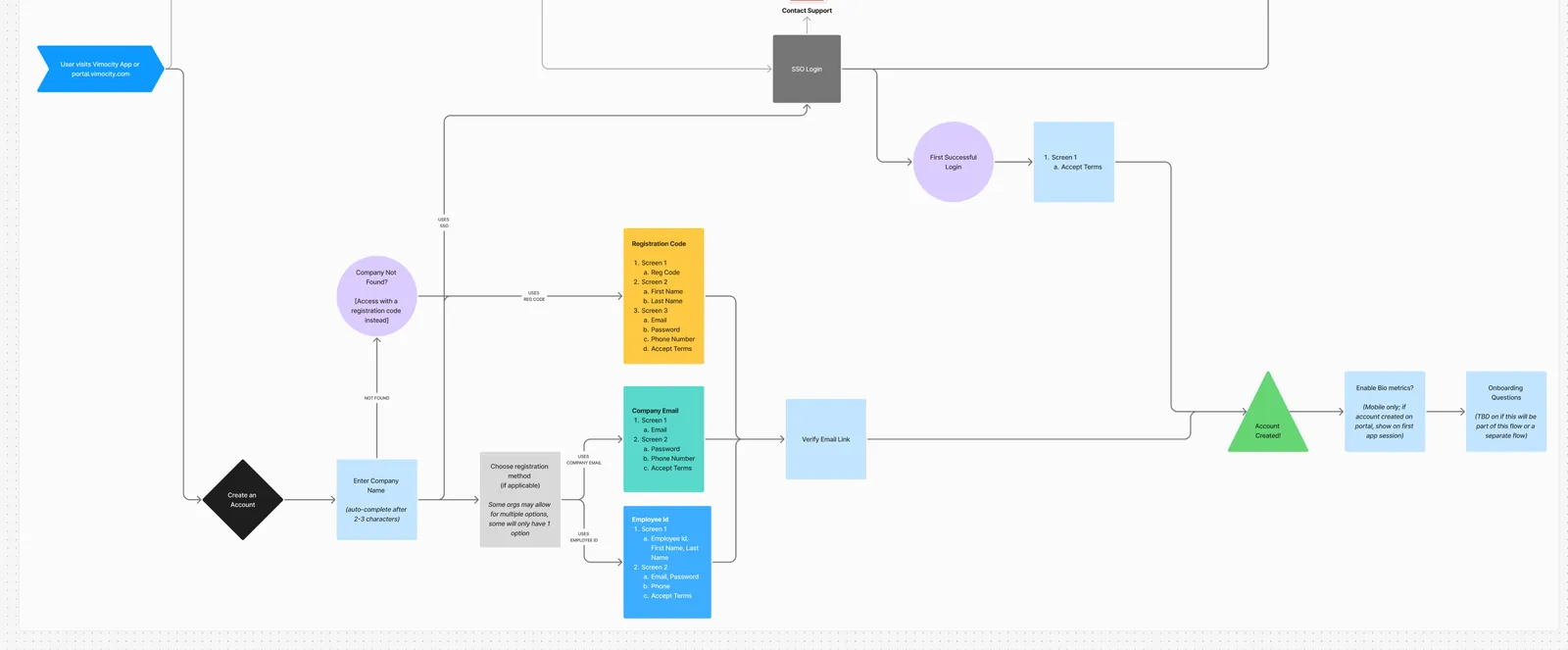
Design challenge: signing in a utility crew on a shared terminal. We designed a magic link first, but it assumes the device reading the email is the device signing in, and for a crew sharing a terminal, it usually isn’t. So we used a six-digit code, which can be read on one device and typed on another.
What I did
- Started with research. Interviews, support tickets, and the five whys showed people weren’t locked out by security. They forgot a password, or which email they’d signed up with. I tested each design with customers.
- Designed for people who forget. “Remember me” keeps your email, and a forgotten password gets a code by email instead of a reset.
- Replaced registration types with a company search. Users answer “Who do you work for?” instead of “Which registration type is yours?”, and get their company’s flow. The list stays empty until you type three letters and includes decoys, so nobody can use it to list our customers.
- Gave admins a way to invite people. Admins see who hasn’t signed up and invite them. About two in three active organizations used it in its first eight months.
- Designed one flow for every platform. One web login runs in the mobile apps and in V-minder, the Windows app, through a webview. We traded a little native polish for one codebase instead of three, the right call for a small team.
Outcome
−80%
login and account-access support tickets
90%+
fewer users hitting a broken password-reset link
Sign-ins held steady through the switch. Security went up, with email verification and multi-factor authentication, without adding steps to the common path.
Who did what: I led the UX research, customer interviews, and UI. Engineering built the flows and the service; product management and leadership shaped the verification requirements.
What I’d change: bring back biometric sign-in first. We prototyped it and cut it to ship sooner.